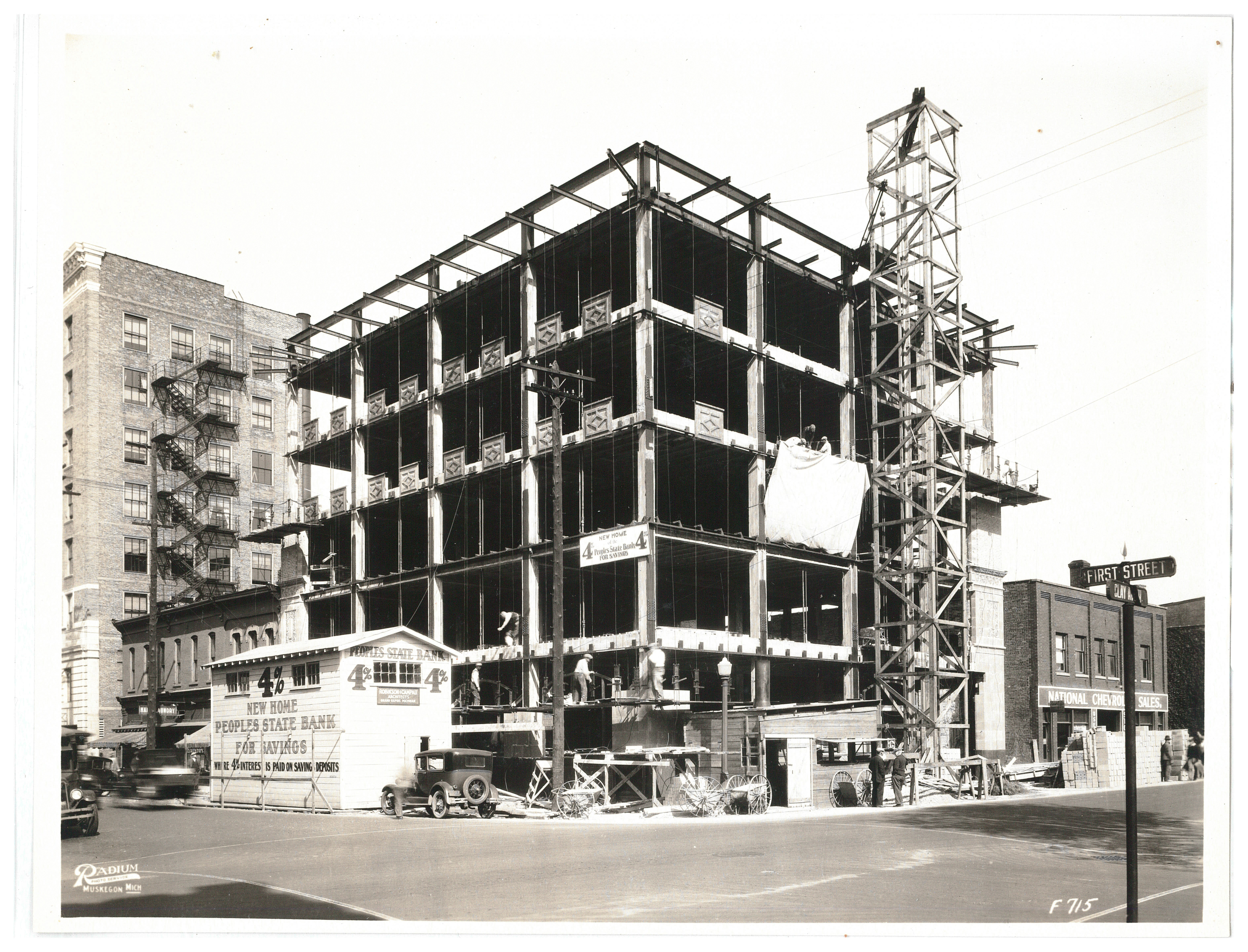
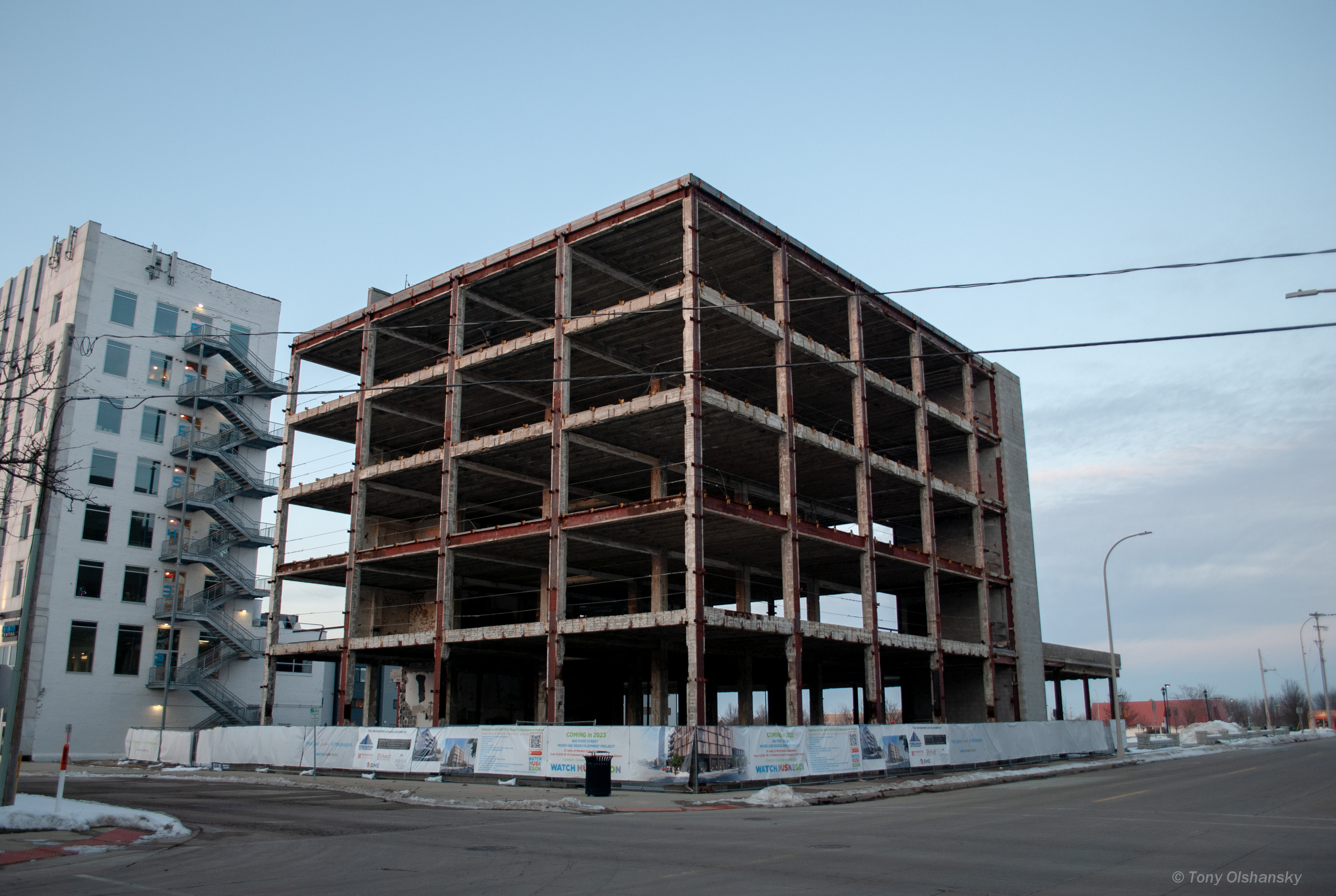
The People’s Savings Bank Under Construction (Circa 1923). (Photo Courtesy of Muskegon Public Library)880 First Street Development, awaiting Construction (2023).
It is easy to say of most midwestern cities that a lot has changed over the last 100 years. Muskegon is unique, however, in the degree of its transformation. From Urban Renewal to industrial implosion, many of the city’s most recognizable features were demolished and replaced, and then in some cases demolished again. This city has relentlessly driven forward.
That is why it feels so uncanny to see a photograph in the city from 100 years ago that looks so remarkably familiar today.
Then, the building was the People’s State Bank, built in 1923. Visitors to the city then could hop off the train and take a streetcar down streets defined by walls of storefronts, grocery stores, hotels, and banks. Since then, the façade of the building down the street has been changed and the buildings either side and down the block are gone, now the site of somebody’s least favorite parking spot. 100 years later, the old People’s State Bank is once again down to its bones.
These bones, however, still hold promise. Construction for this site is slated to begin this spring or summer, and it’s planned to become a mixed use building with 57 apartment units. This new building contributes to the city’s plan to make downtown a place for residents, not just visitors.
Standing on the corner of First and Clay a century ago, it’s easy to imagine a person hopeful about the future of their city as a brand new building fills out. Knowing that those bones still have a potential for life, standing on the corner of First and Clay, I feel hopeful too.
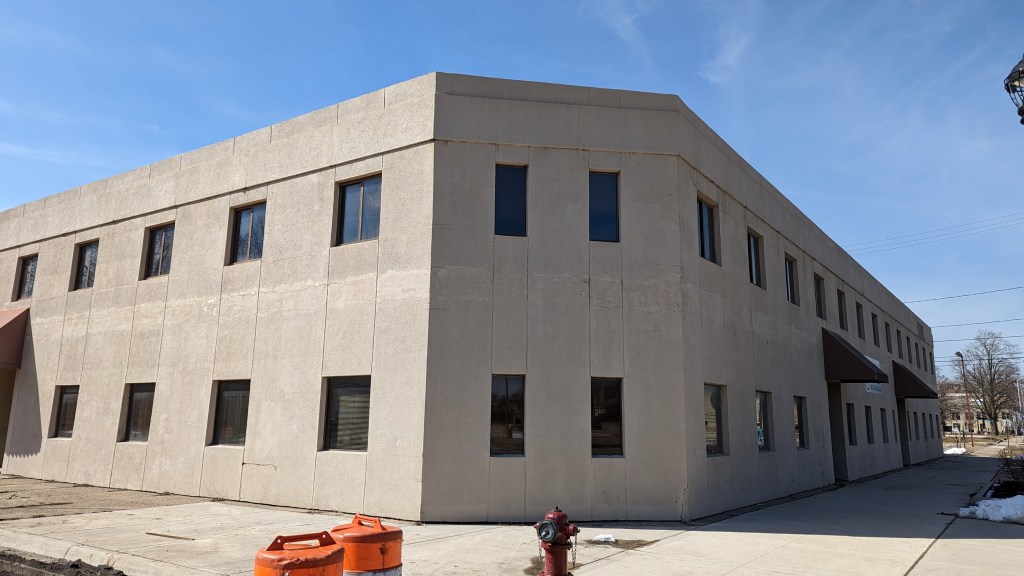
On March 14, 2023 city commissioners directed city staff to recommend West Urban Properties for the development of the property on 1095 Third Street. This property was once the site of Catholic Charities, but is now vacant. Three developers have expressed interest on developing the site, and commissioners had to choose which option to pursue.
Image sourced by author 3/15/23
This will not be the only time this issue will come before the commission, it will have to come before the commission for further approval later. Mayor Johnson did also present the idea that they may reach out to one of the other developers if they reject West Urban Properties down the road.
The main motivation of the commission seemed to be that West Urban Properties would have a portion of their units available for Section 8 vouchers. Commissioner Ramsey suggested that making the section 8 and other vouchers work with this development would set an example to other market rate apartments in the city. Mayor Johnson also noted that more units were proposed by this developer than others.
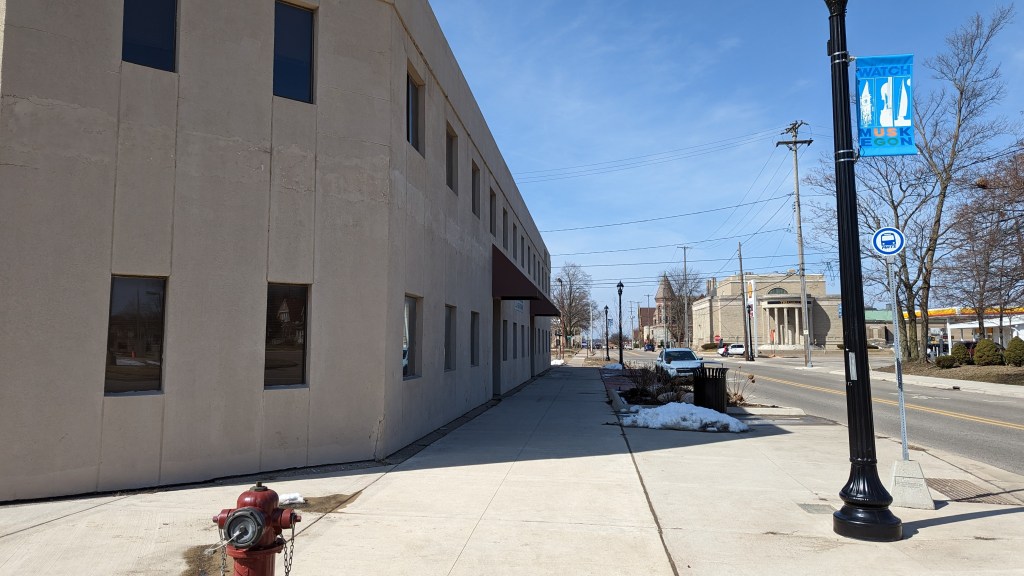
West Urban Properties proposal featured many good urban qualities to make the area more walkable, was mixed use, and would help to enliven and activate Hackley park at more hours, as housing in proximity to that park is currently limited. It is notable that the proposal from all three developers included a historic photo of the building, obviously relating that the building’s facade is worse now than the way it was originally built. Prices for apartments, and how many would be section 8 accepting is to be determined, but this was the only market rate option. The proposals can all be accessed via section 10.d links attached to the meeting agenda here.
Image sourced by author 3/15/23
OPINION: I believe that West Urban Properties was the wrong choice in this location for Muskegon. Muskegon has several large market rate apartment buildings now, and more in the future as Adelaide Pointe and Harbor 31 are constructed. 3rd street is adjacent to downtown, and affordable housing projects there would allow downtown to be more equitably shared by different classes, and not only those wealthy enough to afford it. It is true that more landlords should accept section 8 vouchers, but as the first new development on this side of downtown, affordability should be the priority here. I believe that the General Capital proposal of would be more affordable to more people and would benefit the city of Muskegon and its residents more at this location. General Capital built the Ten 21 affordable apartment building, and their plans included Live/Work lofts and commercial space.
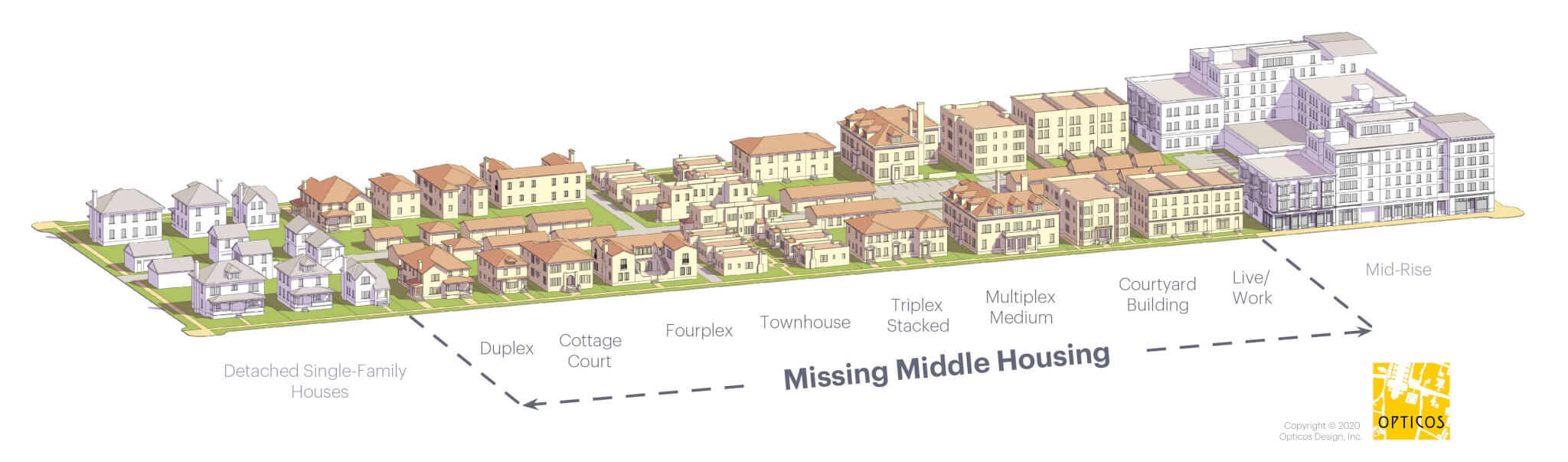
Zoning is the underlying basis for the shape and nature of very many US cities. It separates areas in a city based on how land is used. One area of a city is only allowed to have residential development, while another area is reserved for commercial or industrial use. Zoning ordinances are also usually restrictive about whether a residential area is a single family home, or has multi-family housing. They often restrict aspects of the size and shape of a property. Zoning codes can mandate that a structure has to be a certain distance from the street, can only be so tall, or must provide a certain amount of off-street parking. Combined with redlining, such codes were sometimes designed to segregate people based on class and race. The result in many communities is not only large issues of injustice, but also the elimination of corner stores and “middle housing” like duplexes, townhouses, and fourplexes.
Form based code is also a form of restriction. While the main focus of conventional zoning is use, the main focus of form based code is in the name: form. Form based codes (or FBCs) are mostly concerned with how a building is designed relative to public spaces like streets and sidewalks, usually to improve walkability. They tend to set requirements like maximum distances a building can be from the sidewalk, storefronts that must face the street, and height maximums. The similarities to conventional zoning are pretty clear, but the biggest difference is that form based codes recognize that the way a building interacts with the street is more impactful to livability than whether a laundromat should be allowed rather than a hardware store. FBCs also tend to be more specific geographically by detailing forms sometimes on a street by street basis. The result can be more housing options than just detached houses and apartment buildings. FBCs often encourage triplexes, mixed use buildings, and townhouses in transition areas between less dense single family homes, and denser urban centers.
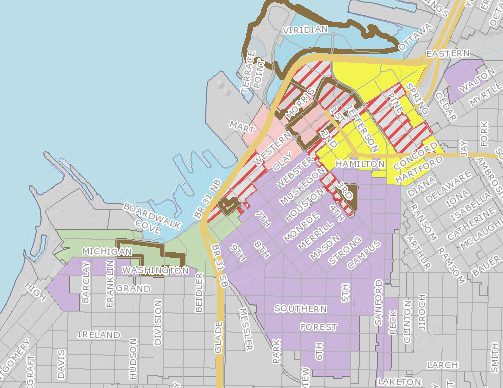
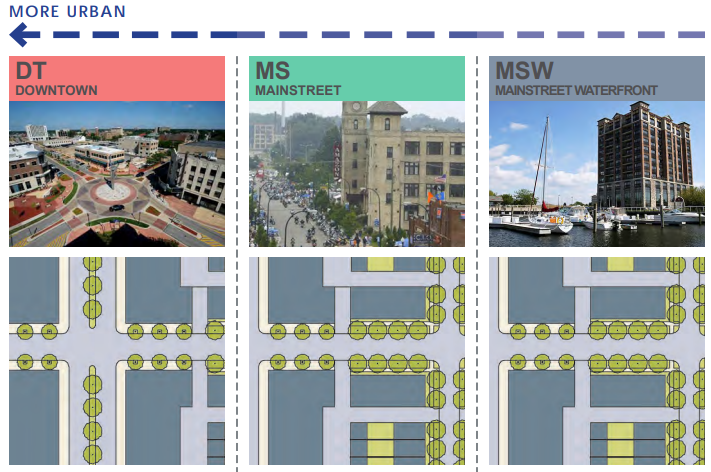
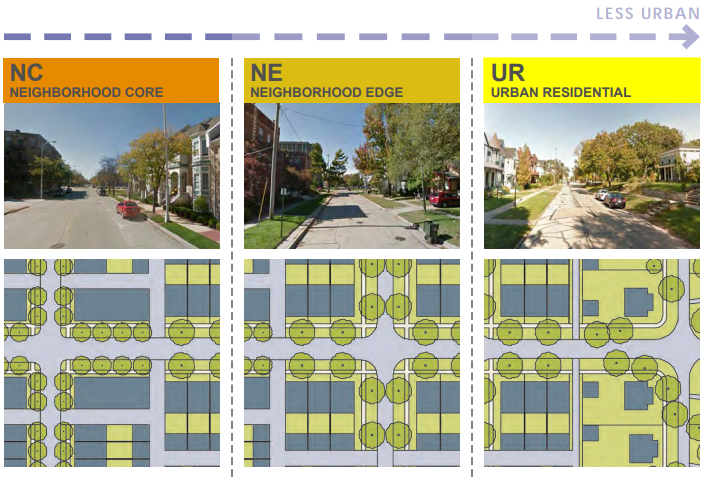
Images and diagrams depicting Context Areas of Muskegon. The entire form base code can be found here.
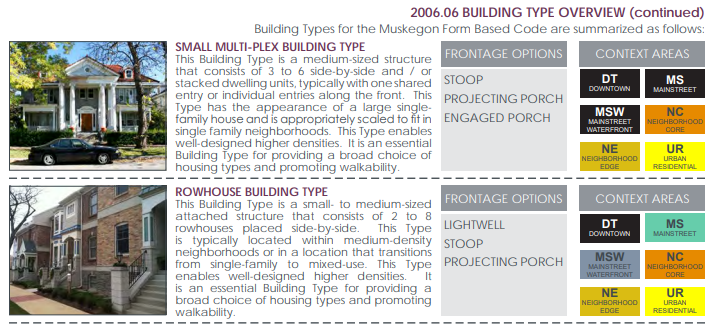
Muskegon’s Form Based Code covers an area centered around downtown, stretching almost as far south as Laketon Ave, and existing in parts of Lakeside, Nims, Nelson, McLaughlin, Angel, and Jackson Hill neighborhoods. A separate FBC is designed specifically for the commercial area in Lakeside around Lakeshore Dr. The code identifies 6 categories, or “Context Areas” that are split; 3 areas are downtown focused, and 3 are neighborhood focused. 10 different building types are also recognized, with varying densities and uses; like Mixed-Use buildings, Large Multiplexes, and Detached Houses. For each building type, there are a variety of frontages described, such as a “forecourt” a small walking courtyard space in front of a large building, or a porch in front of a detached house.
Brief descriptions of two housing types. Blacked out boxes indicate that the building is not allowed in those context areas.
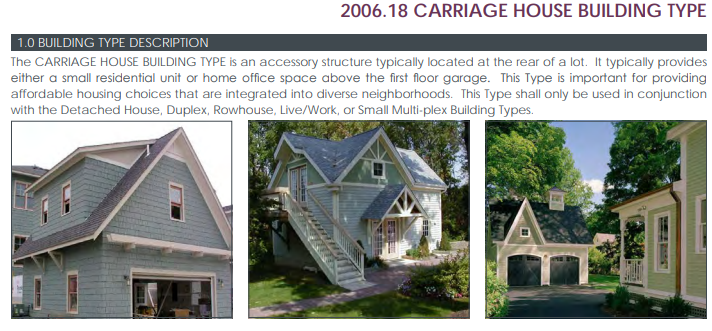
In all, Muskegon’s form based code aims to provide for a transition from a densely urban “Mainstreet” area to a far less dense and less commercial “Urban Residential” area. This series of steps is a reasonable approach to allowing for more housing options, and creating more walkable and liveable streets. The FBC notably allows for “Carriage Houses” or Accessory Dwelling Units. These buildings are meant to be small rental units that are built and maintained by a homeowner on the property of a residential home. These Accessory Dwelling Units can provide a low rent housing solution for some residents, and a secondary source of income for a homeowner. Unfortunately, no buildings of this type seem to have been built as of this writing. A form of living arrangement that is not mentioned in this FBC is Single Room Occupancy units that are used in some cities as low rent options for the unhoused. This could be an area of future improvement.
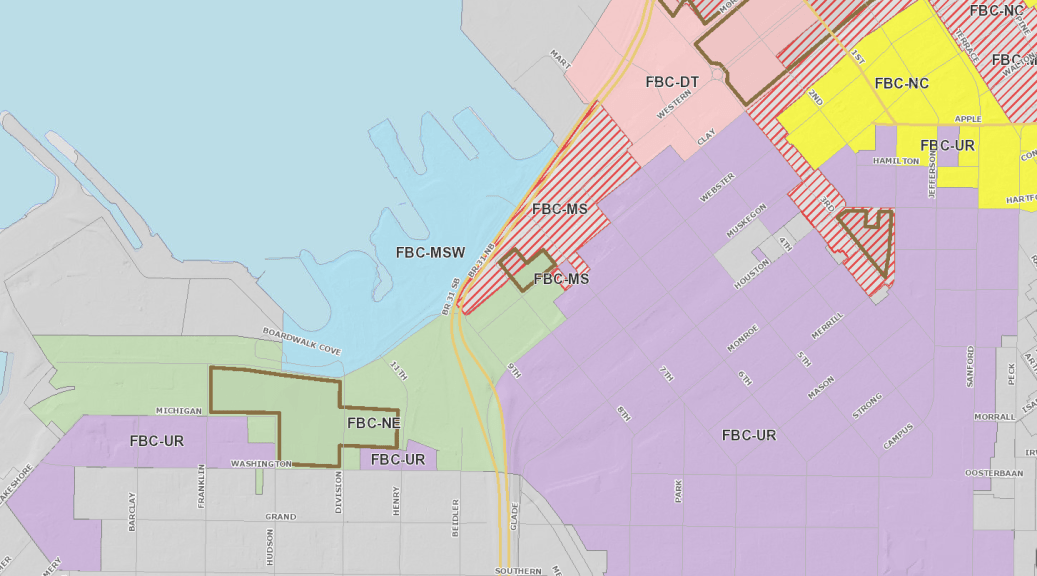
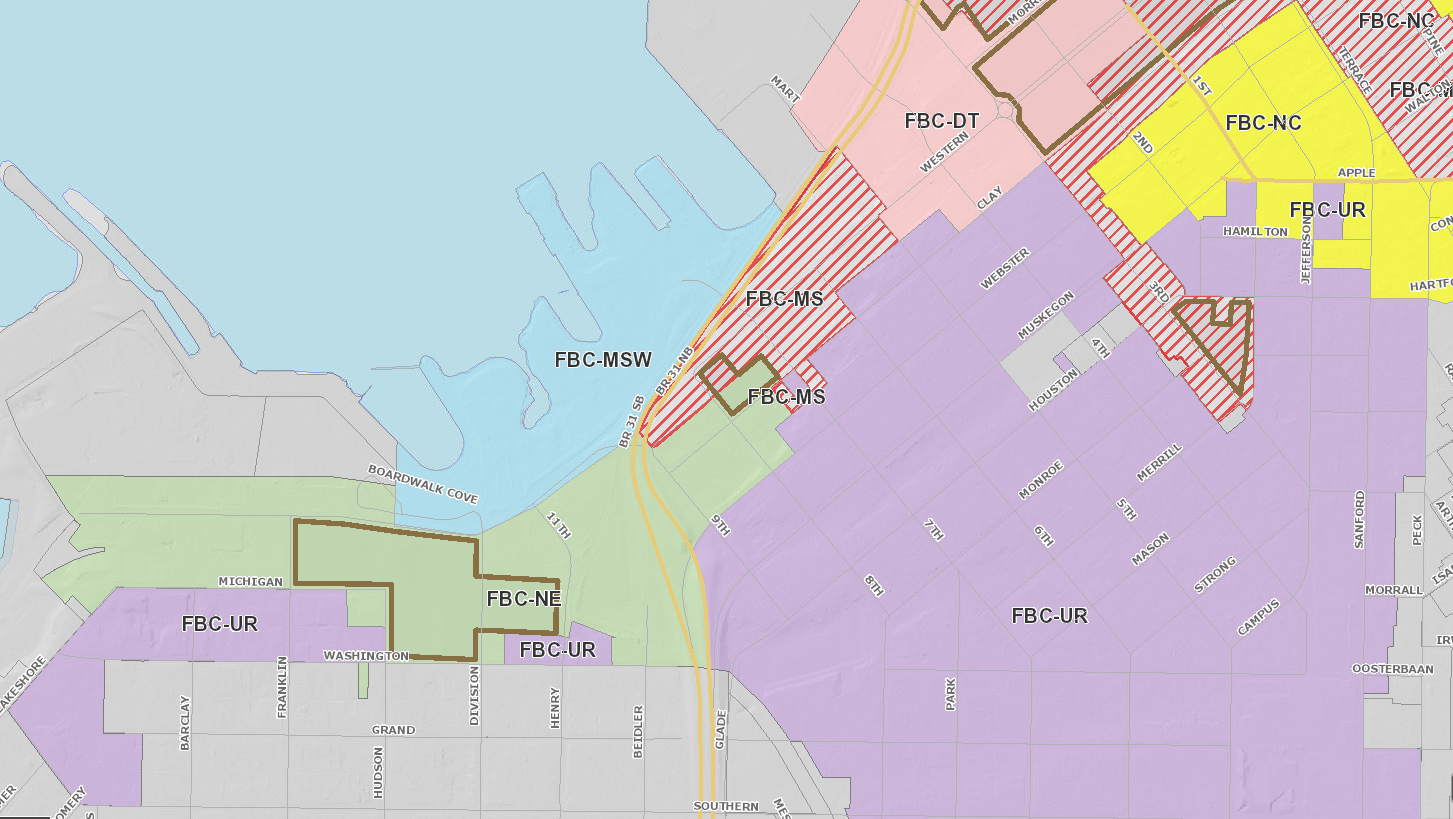
There are some limitations to density that are built into the city’s Form Based Code, particularly in the Neighborhood Edge and Urban Residential areas. The Neighborhood Edge area allows for a large amount of building types, including single family homes. Considering the limited size and location of the Neighborhood Edge area mostly in Nims, and the fact that the vast majority of Muskegon and the four cities surrounding it is zoned exclusively for single family homes, I would remove them as an option for the Neighborhood Edge. I would also expand the neighborhood edge in Nelson Neighborhood as a buffer between the “Neighborhood Core” and “Urban Residential” areas that are currently zoned adjacent to each other.
A zoomed in image of Muskegon’s Form Based Code. Neighborhood Edge is green, Neighborhood Core is yellow, and Urban Core is purple.
The weakest part of Muskegon’s Form Based Code is the Planned Unit Development, or PUD. This is a special provision that allows for a development to forgo rules imposed by the FBC. It’s purpose is to accommodate developments on sites with unusual topography or settings that make developing uniquely difficult. The danger is that in the process, large areas of the city are developed in a manner that is antithetical to the urban character of their original zoning. Harbor 31 is an example of this. Harbor 31 sits within effectively the entirety of the “Mainstreet Waterfront” area, which was intended to
“Provide a waterfront focal point that serves the city’s neighborhoods and the region by accommodating retail, service, and residential uses in a compact, walkable urban form.”
Instead, when it is built, it will effectively be designed similarly to a suburban condo complex. It does have guaranteed access to lakefront in two areas, but at the cost of the walkable public streetscape that this area could have been. Considering this development, future PUDs should be regarded with great skepticism.
In all, Muskegon’s Form Based Code is an asset to the city, and an aspect that sets us apart from many other cities in Michigan. It is a key part to making Muskegon a more walkable and interesting city to live in, and if the housing options it allows are actually built, it may lead to a more robust and affordable range of housing options in the future.
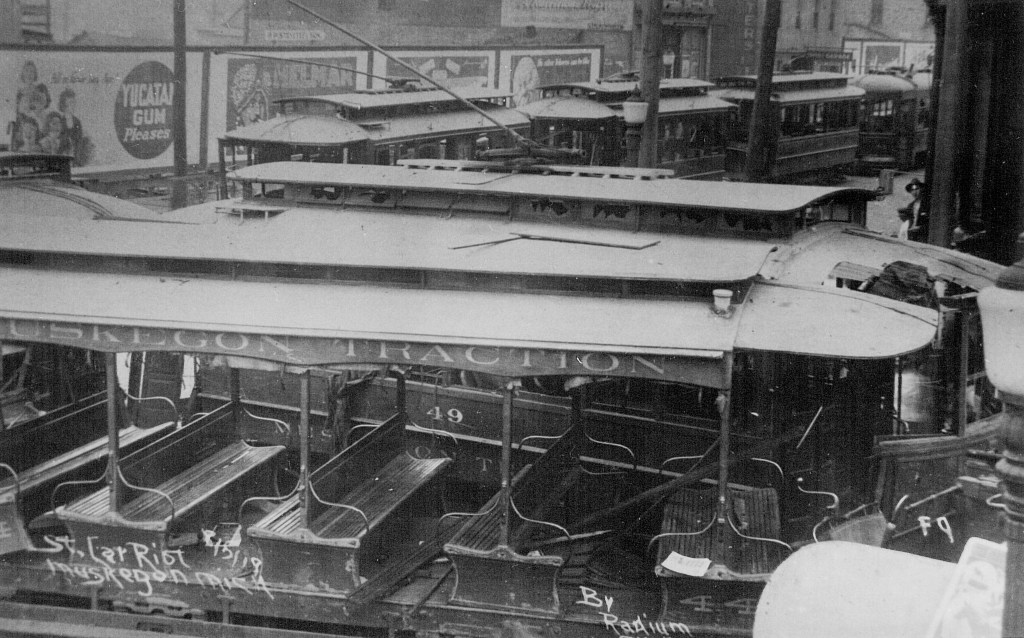
For many in Muskegon today, taking the trolley would mean riding the high end painted bus that is available for rental for weddings and other special occasions. One hundred years ago however, the streetcar was a vital form of transportation for the city. In the early 1900s, few Muskegonites owned automobiles, and most took streetcars, busses, or walked to get to work, and go shopping. Because the streetcars of Muskegon were so vital, when the Muskegon Traction Company raised the ride fare by 1 cent in August of 1919, it began a riot that lasted through the night, destroying streetcars and causing chaos in the city.
It started with a sudden rate increase from 6 to 7 cents in early August, 1919. On August 5th, around 6pm on Jefferson near city hall, a number of working men refused to pay more than 6 cents for their ride fare, resulting in arguments with staff. This lead to blocked traffic, where the streetcar blocked other cars from continuing on the tracks. Men started to push cars off the tracks around 7:30.
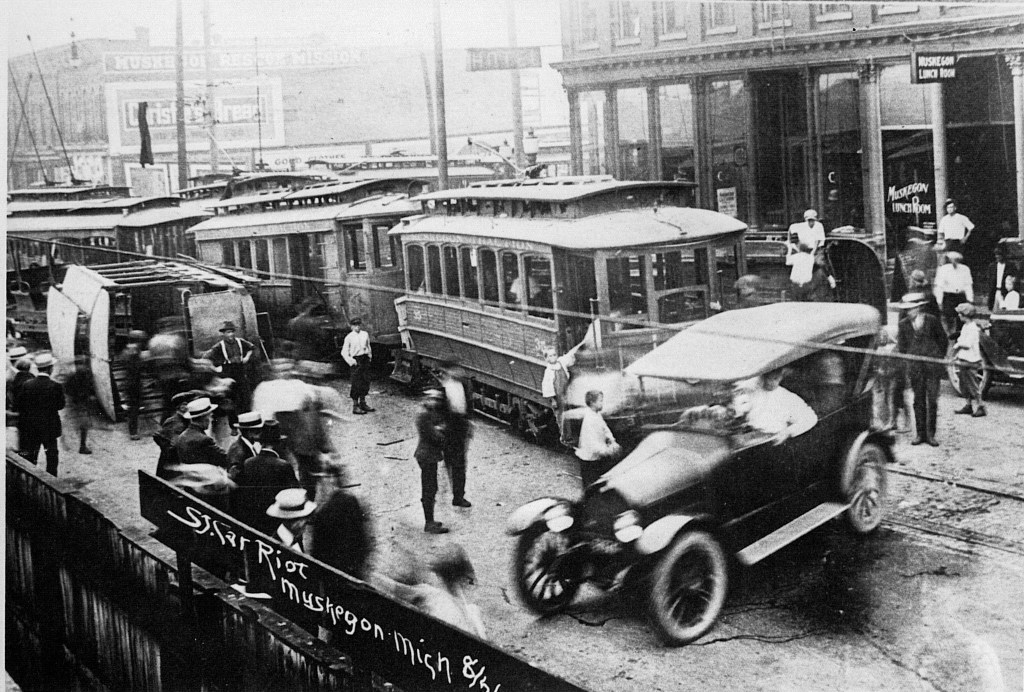
Photos courtesy of Muskegon Public Library
Meanwhile half a block away at city hall, commissioners hurriedly passed an ordinance capping fares at 6 cents, limiting Traction Company’s franchise to 20 years instead of the previously agreed upon 30, and mandating that cars operate at least every 10 minutes (In Muskegon today, busses come every hour.) They also gave power to the Mayor to stop the lines for the day to prevent riots, not realizing that the mayor already had that power. Unfortunately it was too late.
Across the city, crowds formed around cars, and all 15 cars out on the streets were turned over, and damaged as they lay on their sides. One man was seriously injured when, while standing on top of a turned over car, he fell through the window. The majority of the crowds were apparently boys, ages 12 to 18. By 11:00pm, a thousand person crowd moved from the corner of Pine and Western to the Streetcar Barn. They forced their way in, undeterred by warning shots fired by the police. There they started to damage the remaining streetcars, and offices inside the barn. On Western, they started pushing streetcars downhill into other cars. At around 2am on August 6th, one of the larger cars was set on fire, and the Muskegon Chronicle reported the next day that the rioting continued until after 3 o’clock in the morning.
Bystanders viewing the destruction on August 6, 1919.
The next morning, hundreds came out to view the destruction of the streetcars, as efforts were made to clear the streets of debris. Children played around the destroyed hulks lying in the streets. With a fog rolling in from the lake over the smoldering ruins, a reporter likened it to a battleground. Hundreds of workers got up early and walked to work to arrive on time, while others got rides from busses and company trucks. The Mayor urged those who owned “autos” to drive their neighbors into work. Practically every streetcar, 30 in all, were damaged including 12 that were completely demolished.
Headline of the Muskegon Chronicle August 6, 1919.
Many cities in the early 20th century United States had streetcar systems, though very few of them have survived to today. Muskegon was obviously not one one of those few exceptions, but at least the streetcar did have one memorable night in the lakeside city that remains a part of our history. Streetcars continued to run for years in the city, but continued to struggle until they became nothing but a background piece in old postcards. Maybe through remembering this one chaotic night, we can reignite interest in creating a more reliable and ingrained public transportation system in the future.
On January 24, city commissioners voted no on an amendment to the development agreement with Parkland Marina, LLC which originally terminated public access to a break-wall with a walkway, railing, and scenic views of Muskegon Lake in 2021.
This comes as a lawsuit has been filed against the city by the adjacent land-owner Mart Dock, which alleges that the city improperly gave the land away without consideration. This lawsuit was determined by the circuit judge to have enough merit to continue to litigation, and it was expressed at the meeting by the city’s legal council that they had a limited time to address the lawsuit’s claims before litigation would proceed.
The amendment was thus a concerted effort to address the issues highlighted in the lawsuit. In short, the agreement stipulated public access to the boardwalk and the walk itself, and that Parkland, “may relocate the path of the public access to a comparable location, to facilitate its development of the Property.” This process of relocating public access would have to be reviewed and approved by city council before a building permit would be issued for it. It also would have reinstated the same access as was available under the previous public access dedication, “until Parkland commences construction of the Project.”
The rest of the amendment attempted to address other legal concerns, first by raising the amount of money given to the city for the land to $25,000 instead of $2. It explained that the new price is still low because 1) The land is under an easement that only allows access to Parkland anyway, 2) the land is contaminated, and 3) Parkland is legally required to invest millions into the property. Finally, the amendment would have required that the short road that leads to the boardwalk be vacated, to address Mart Dock’s allegation that the road was a public street, which could not be given away without some higher level of consideration. The City considered that road to be a driveway.
The council meeting all told was 4 hours long including other business. Most notably, the public comment section included over seven members of the public urging commissioners to vote no on the amendment. In every case it was clear that commenters wanted public access to the walkway, but not clear what about the amendment they specifically disagreed with. A few took issue with the idea of a boat storage business on the property at all. One gentleman was so passionate that after lapsing his time, he continued to speak over the mayor’s gavel and threats to have him removed. Channel 13 did have a camera present.
The city commissioners seemed to be at a loss over the amendment. They wrestled with passing an amendment so hotly opposed by a room of concerned citizens, or rejecting it and thus denying any access at all. In the end, all but the Mayor seemed to believe that inaction would be better than passing the amendment and accidentally creating a bigger problem down the road. The Mayor, Ken Johnson, voted for the amendment, believing that it provided sufficient access while safeguarding it into the future. All the while legal council was very adamant that there would be great l risk should the lawsuit continue. With no amendment now, the future is unclear.
OPINION: Everyone involved wants public access. Parkland wants it in a way that will help its business. Commissioners want it for the public. The Mayor and city civil servants want it and want to avoid a lawsuit. Mart Dock probably wants it so that they can trade the adjoining parcel for Fisherman’s Landing (although Parkland’s owner alleged in the meeting they were suing to hurt their business competition.) The real question is how we are going to get it. The biggest issue with this amendment was that it was written by the city manager primarily to address a lawsuit. It wasn’t crafted with public input, or debated and discussed before it was introduced. That may have been a result of the limited time afforded by the lawsuit. Either way, we are now at the mercy of this lawsuit, which may hopefully end in public access someday, and will certainly cost the city money that should really be going to something better than defending a poor decision. I can only hope that Mart Dock will come to some agreement quickly that codifies public access.
One thing I will say is that the Mayor wants public access too, and has pursued it even before it came into the public eye. He bore the brunt of a lot of anger on Tuesday. The amendment, though imperfect, seemed to come under a disproportionate amount of opposition because it was difficult to understand, or because people really don’t want a boat storage business there at all. I am proud of how many people really care about our access to this beautiful lake. As one commenter put it, we’re “lake people.”
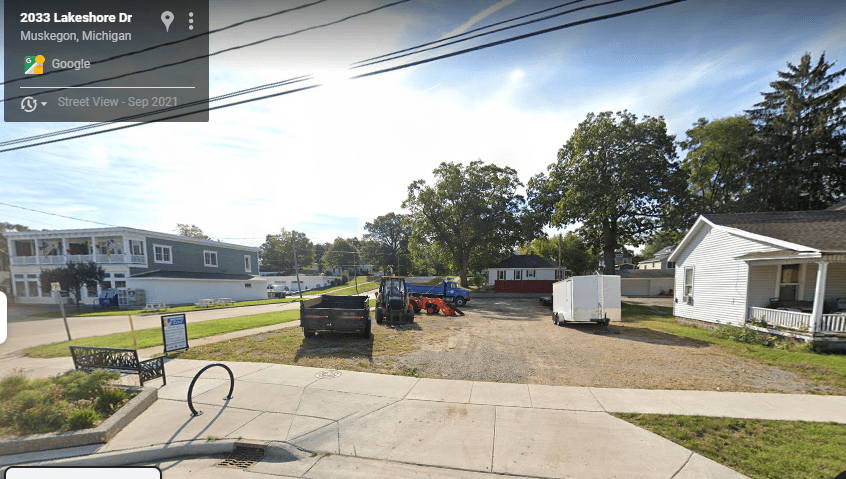
City Commissioners approved a planned unit development (PUD) located at 2033 and 2044 Lakeshore Drive in Muskegon on August 23. Lot 2033 sits on the corner of Moon Street and Lakeshore Drive in the Lakeside neighborhood. The approved PUD granted to Tiny Digs Muskegon LLC allows for 10 “Micro-lodging” units. The units are to be used only for short term stays of 30 days or less by definition, although actual stay limits may be less than that. A stipulation was also included that 5 canopy trees be planted along Moon Street.
A view of the corner of Moon and Lakeshore as of September 2021 (Google Street View, 9/06/2022)
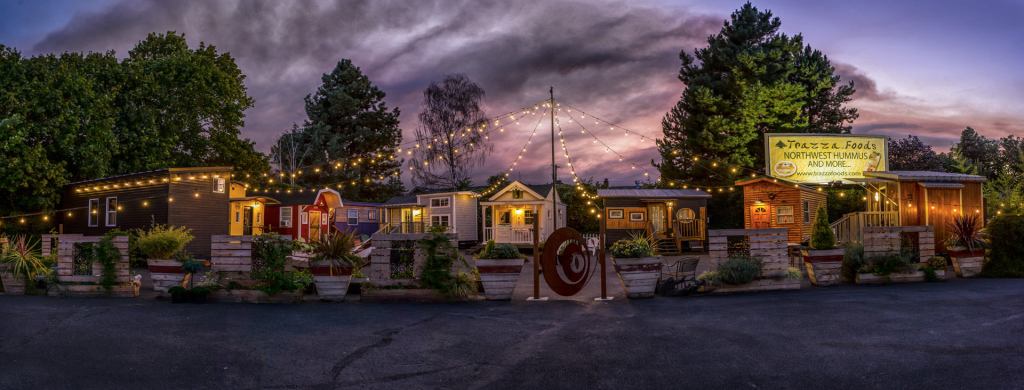
Tiny Digs is not new to the tiny homes rental scene. They operate a similar business in Portland, Oregon. The hotel in Portland features a variety of tiny homes which range in styles and colors, and sleep a range of 2 to 5 guests. The representative of Tiny Digs Muskegon told the council that the aim is for a maximum of 2 to 4 guests in each unit at Lakeshore Dr. at a time. This is due to the limitations the size of the lot will impose on the sizes of the units. The representative also mentioned that the aesthetic character of the development would be pleasant and described it in a way that sounded quite suburban, even describing a possible white picket fence.
There were many concerns raised at the city commission meeting on the 23rd, from both nearby residents and city commissioners. Most questions seemed to be sufficiently answered by the time a vote came to pass with the exception of parking. The site is not in an area that has parking minimums, and there are currently no planned parking spots on-site for guests. Instead, Tiny Digs has arranged for parking at the lots of nearby businesses. Mayor Ken Johnson raised the concern about this arrangement disappearing in the event that those businesses are sold. This point did not seem to be properly answered, which lead to what seemed to be general confusion among commission members. At one point the commission seemed to make an effort to postpone voting on the issue in order that the concerns of those outspoken against the PUD be addressed. However, commissioner Hood made a motion to adopt the PUD. The motion passed 4-1, with Mayor Johnson being the only no vote. Commissioner Gorman and Commissioner Ramsey were absent.
OPINION: The pros most likely outweigh the cons for this development. Although some residents brought up the concern that the lots could service a larger and more dense building, my hope is that the existence of these short term rental units encourages exactly that sort of high density development throughout the Lakeside Form-Based code area. My hope is that these tiny homes act as a buffer between the commercial and residential areas, and bring more commercial interest to the Lakeside neighborhood without being a nuisance to nearby single family homes. This development also sparked a conversation on parking which will hopefully be a part of a transition in thinking away from parking as an immediately available resource everywhere in the city.
News and History for Pursuing a More Liveable City of Muskegon


 The Muskegon Lumberman