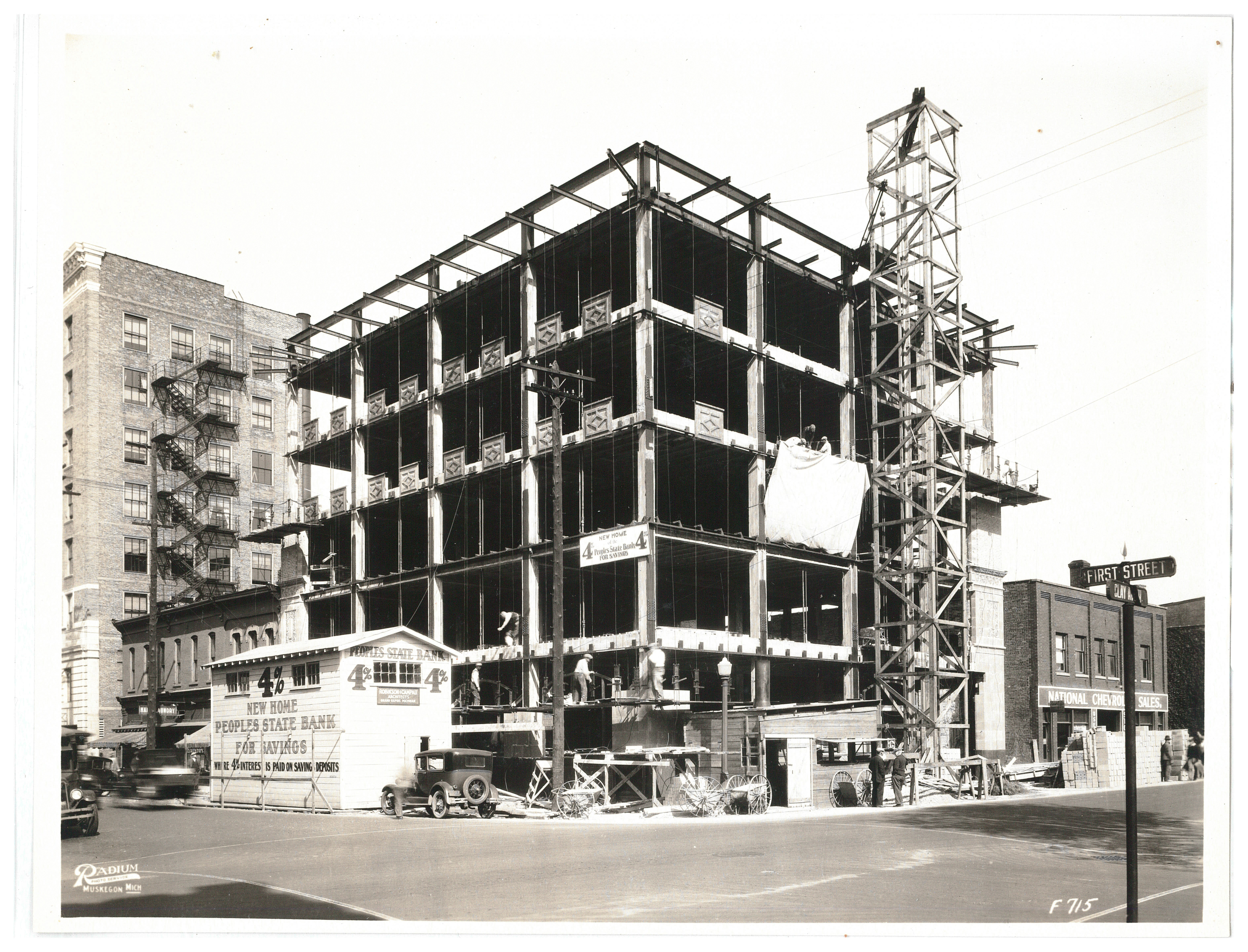
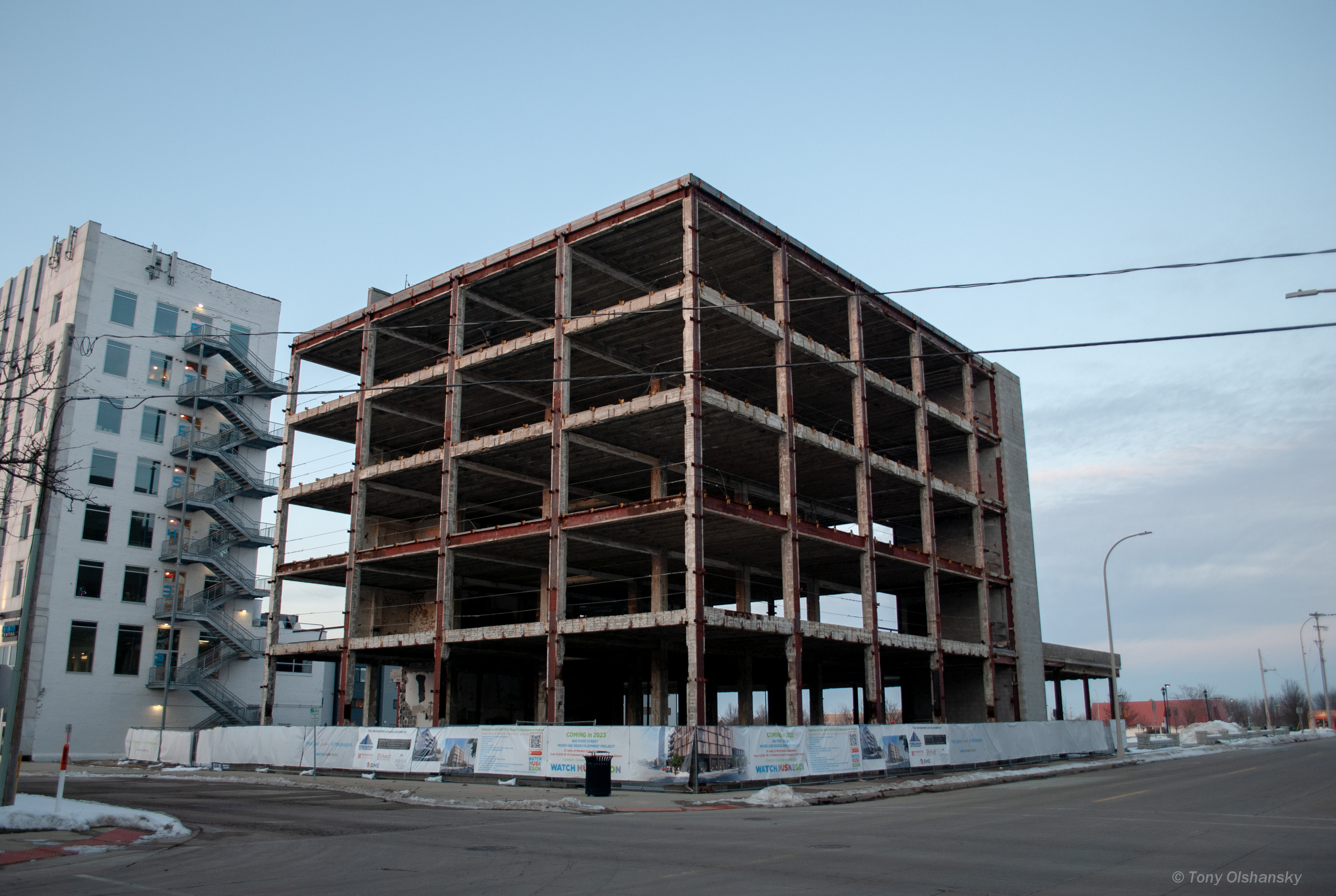
The People’s Savings Bank Under Construction (Circa 1923). (Photo Courtesy of Muskegon Public Library)880 First Street Development, awaiting Construction (2023).
It is easy to say of most midwestern cities that a lot has changed over the last 100 years. Muskegon is unique, however, in the degree of its transformation. From Urban Renewal to industrial implosion, many of the city’s most recognizable features were demolished and replaced, and then in some cases demolished again. This city has relentlessly driven forward.
That is why it feels so uncanny to see a photograph in the city from 100 years ago that looks so remarkably familiar today.
Then, the building was the People’s State Bank, built in 1923. Visitors to the city then could hop off the train and take a streetcar down streets defined by walls of storefronts, grocery stores, hotels, and banks. Since then, the façade of the building down the street has been changed and the buildings either side and down the block are gone, now the site of somebody’s least favorite parking spot. 100 years later, the old People’s State Bank is once again down to its bones.
These bones, however, still hold promise. Construction for this site is slated to begin this spring or summer, and it’s planned to become a mixed use building with 57 apartment units. This new building contributes to the city’s plan to make downtown a place for residents, not just visitors.
Standing on the corner of First and Clay a century ago, it’s easy to imagine a person hopeful about the future of their city as a brand new building fills out. Knowing that those bones still have a potential for life, standing on the corner of First and Clay, I feel hopeful too.
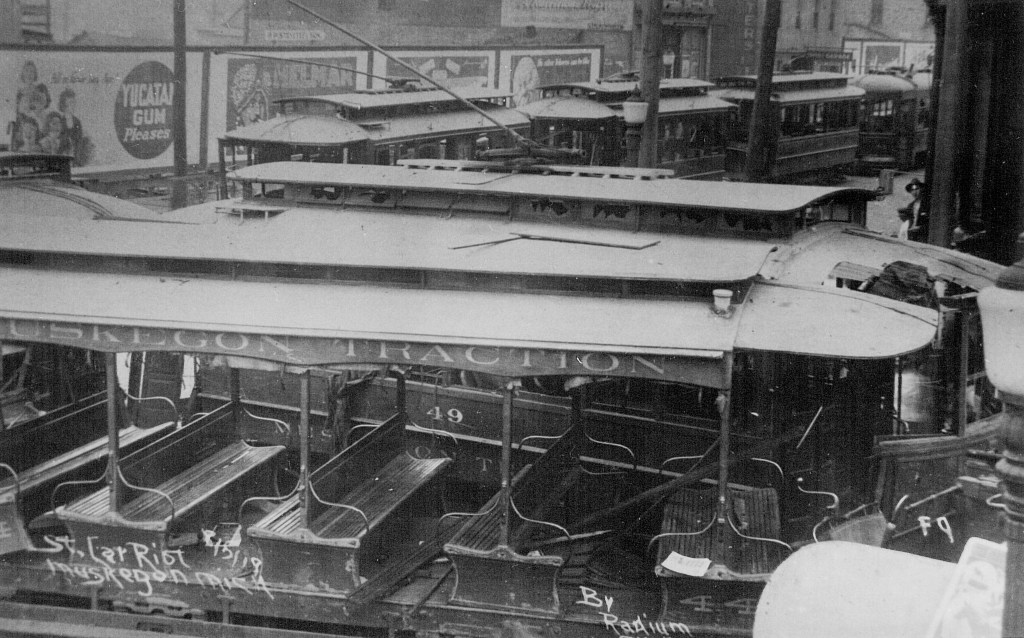
For many in Muskegon today, taking the trolley would mean riding the high end painted bus that is available for rental for weddings and other special occasions. One hundred years ago however, the streetcar was a vital form of transportation for the city. In the early 1900s, few Muskegonites owned automobiles, and most took streetcars, busses, or walked to get to work, and go shopping. Because the streetcars of Muskegon were so vital, when the Muskegon Traction Company raised the ride fare by 1 cent in August of 1919, it began a riot that lasted through the night, destroying streetcars and causing chaos in the city.
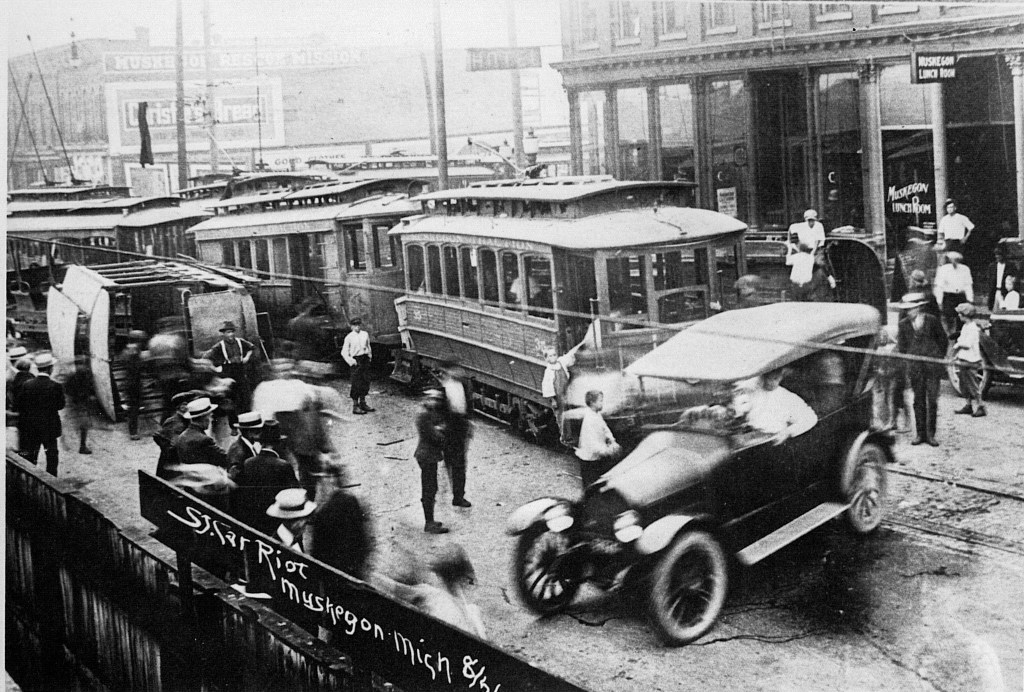
It started with a sudden rate increase from 6 to 7 cents in early August, 1919. On August 5th, around 6pm on Jefferson near city hall, a number of working men refused to pay more than 6 cents for their ride fare, resulting in arguments with staff. This lead to blocked traffic, where the streetcar blocked other cars from continuing on the tracks. Men started to push cars off the tracks around 7:30.
Photos courtesy of Muskegon Public Library
Meanwhile half a block away at city hall, commissioners hurriedly passed an ordinance capping fares at 6 cents, limiting Traction Company’s franchise to 20 years instead of the previously agreed upon 30, and mandating that cars operate at least every 10 minutes (In Muskegon today, busses come every hour.) They also gave power to the Mayor to stop the lines for the day to prevent riots, not realizing that the mayor already had that power. Unfortunately it was too late.
Across the city, crowds formed around cars, and all 15 cars out on the streets were turned over, and damaged as they lay on their sides. One man was seriously injured when, while standing on top of a turned over car, he fell through the window. The majority of the crowds were apparently boys, ages 12 to 18. By 11:00pm, a thousand person crowd moved from the corner of Pine and Western to the Streetcar Barn. They forced their way in, undeterred by warning shots fired by the police. There they started to damage the remaining streetcars, and offices inside the barn. On Western, they started pushing streetcars downhill into other cars. At around 2am on August 6th, one of the larger cars was set on fire, and the Muskegon Chronicle reported the next day that the rioting continued until after 3 o’clock in the morning.
Bystanders viewing the destruction on August 6, 1919.
The next morning, hundreds came out to view the destruction of the streetcars, as efforts were made to clear the streets of debris. Children played around the destroyed hulks lying in the streets. With a fog rolling in from the lake over the smoldering ruins, a reporter likened it to a battleground. Hundreds of workers got up early and walked to work to arrive on time, while others got rides from busses and company trucks. The Mayor urged those who owned “autos” to drive their neighbors into work. Practically every streetcar, 30 in all, were damaged including 12 that were completely demolished.
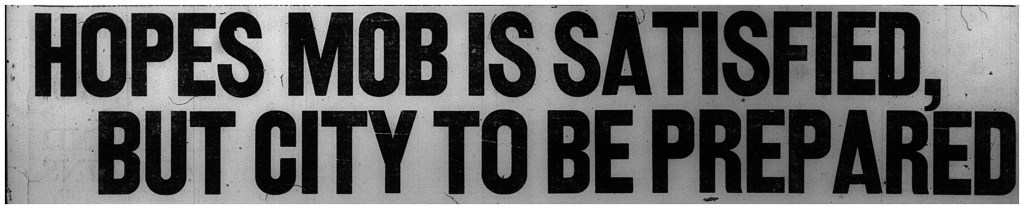
Headline of the Muskegon Chronicle August 6, 1919.
Many cities in the early 20th century United States had streetcar systems, though very few of them have survived to today. Muskegon was obviously not one one of those few exceptions, but at least the streetcar did have one memorable night in the lakeside city that remains a part of our history. Streetcars continued to run for years in the city, but continued to struggle until they became nothing but a background piece in old postcards. Maybe through remembering this one chaotic night, we can reignite interest in creating a more reliable and ingrained public transportation system in the future.
News and History for Pursuing a More Liveable City of Muskegon

 The Muskegon Lumberman