
Zoning is the underlying basis for the shape and nature of very many US cities. It separates areas in a city based on how land is used. One area of a city is only allowed to have residential development, while another area is reserved for commercial or industrial use. Zoning ordinances are also usually restrictive about whether a residential area is a single family home, or has multi-family housing. They often restrict aspects of the size and shape of a property. Zoning codes can mandate that a structure has to be a certain distance from the street, can only be so tall, or must provide a certain amount of off-street parking. Combined with redlining, such codes were sometimes designed to segregate people based on class and race. The result in many communities is not only large issues of injustice, but also the elimination of corner stores and “middle housing” like duplexes, townhouses, and fourplexes.
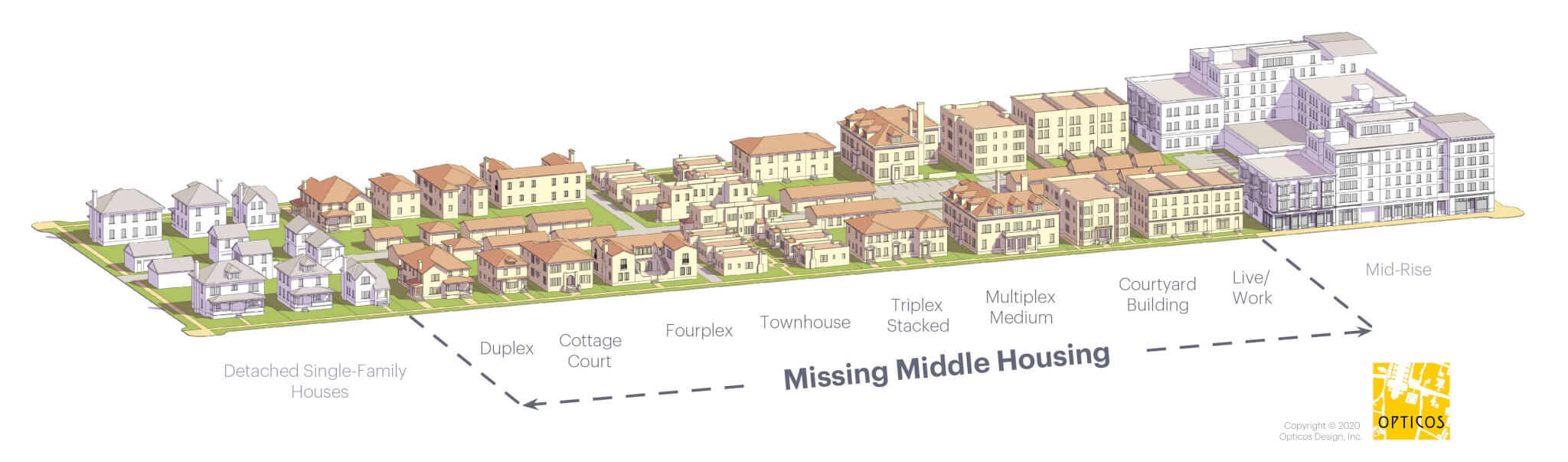
Form based code is also a form of restriction. While the main focus of conventional zoning is use, the main focus of form based code is in the name: form. Form based codes (or FBCs) are mostly concerned with how a building is designed relative to public spaces like streets and sidewalks, usually to improve walkability. They tend to set requirements like maximum distances a building can be from the sidewalk, storefronts that must face the street, and height maximums. The similarities to conventional zoning are pretty clear, but the biggest difference is that form based codes recognize that the way a building interacts with the street is more impactful to livability than whether a laundromat should be allowed rather than a hardware store. FBCs also tend to be more specific geographically by detailing forms sometimes on a street by street basis. The result can be more housing options than just detached houses and apartment buildings. FBCs often encourage triplexes, mixed use buildings, and townhouses in transition areas between less dense single family homes, and denser urban centers.
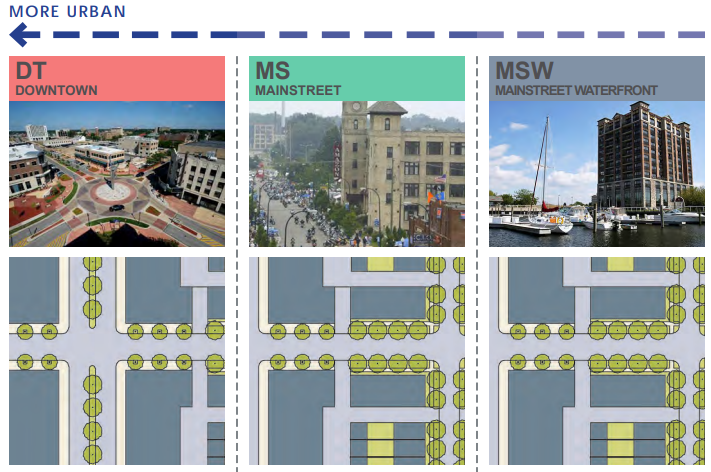
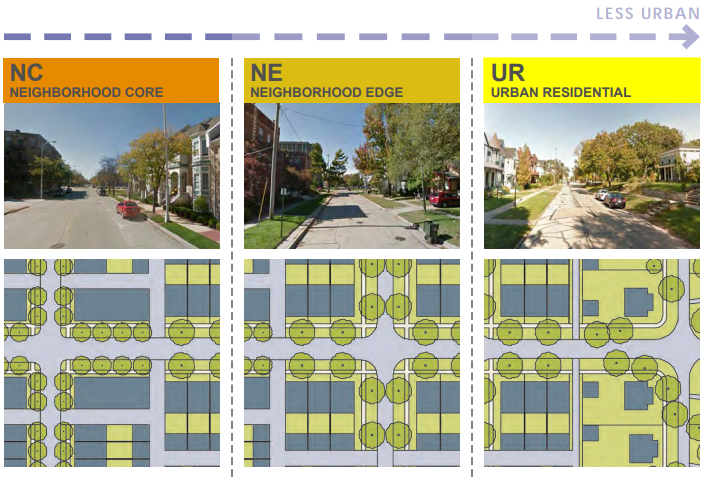
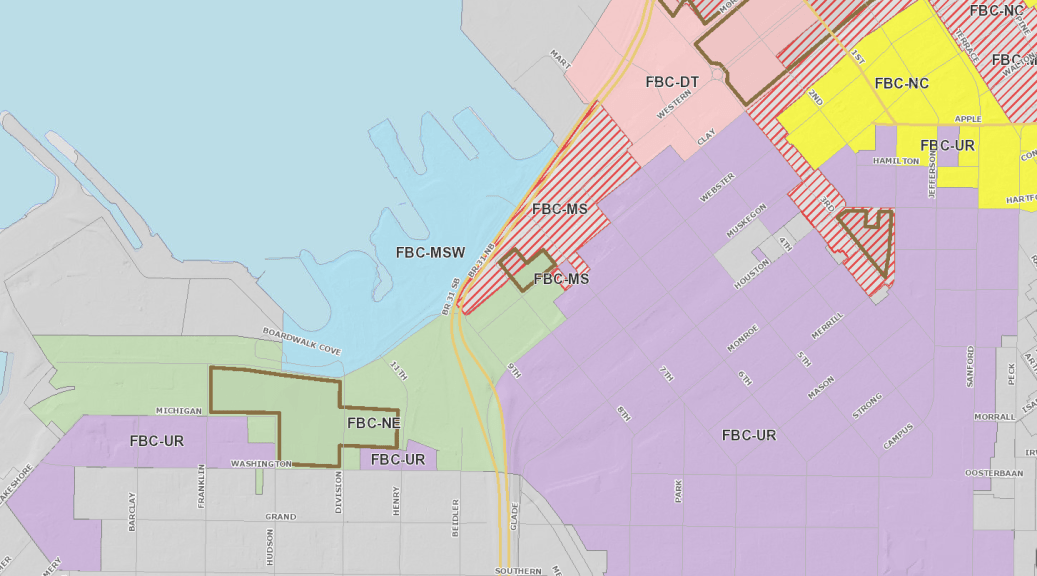
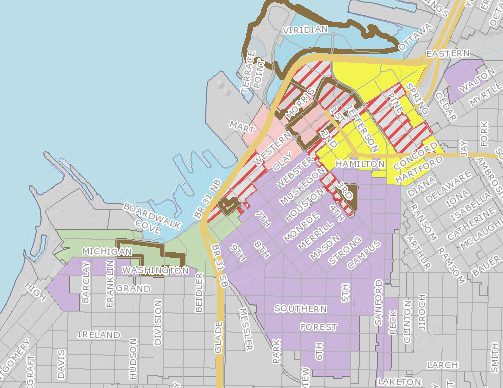
Muskegon’s Form Based Code covers an area centered around downtown, stretching almost as far south as Laketon Ave, and existing in parts of Lakeside, Nims, Nelson, McLaughlin, Angel, and Jackson Hill neighborhoods. A separate FBC is designed specifically for the commercial area in Lakeside around Lakeshore Dr. The code identifies 6 categories, or “Context Areas” that are split; 3 areas are downtown focused, and 3 are neighborhood focused. 10 different building types are also recognized, with varying densities and uses; like Mixed-Use buildings, Large Multiplexes, and Detached Houses. For each building type, there are a variety of frontages described, such as a “forecourt” a small walking courtyard space in front of a large building, or a porch in front of a detached house.
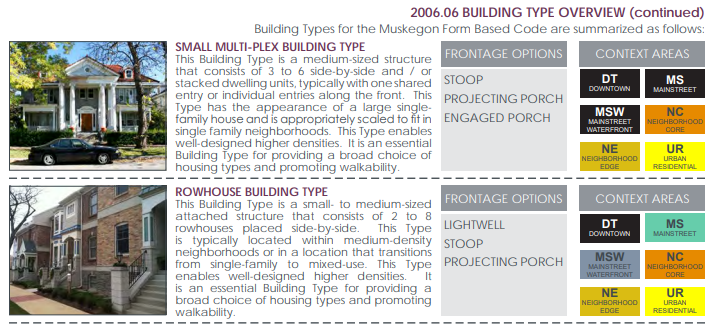
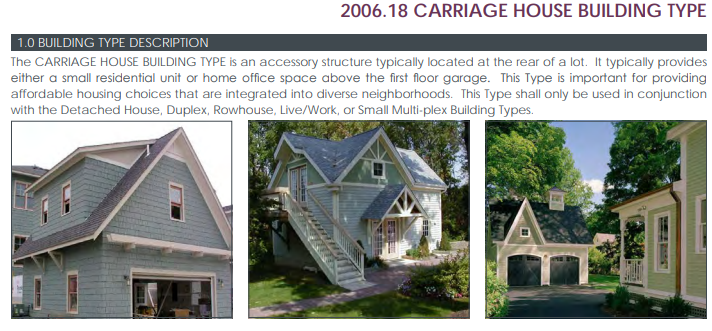
In all, Muskegon’s form based code aims to provide for a transition from a densely urban “Mainstreet” area to a far less dense and less commercial “Urban Residential” area. This series of steps is a reasonable approach to allowing for more housing options, and creating more walkable and liveable streets. The FBC notably allows for “Carriage Houses” or Accessory Dwelling Units. These buildings are meant to be small rental units that are built and maintained by a homeowner on the property of a residential home. These Accessory Dwelling Units can provide a low rent housing solution for some residents, and a secondary source of income for a homeowner. Unfortunately, no buildings of this type seem to have been built as of this writing. A form of living arrangement that is not mentioned in this FBC is Single Room Occupancy units that are used in some cities as low rent options for the unhoused. This could be an area of future improvement.
There are some limitations to density that are built into the city’s Form Based Code, particularly in the Neighborhood Edge and Urban Residential areas. The Neighborhood Edge area allows for a large amount of building types, including single family homes. Considering the limited size and location of the Neighborhood Edge area mostly in Nims, and the fact that the vast majority of Muskegon and the four cities surrounding it is zoned exclusively for single family homes, I would remove them as an option for the Neighborhood Edge. I would also expand the neighborhood edge in Nelson Neighborhood as a buffer between the “Neighborhood Core” and “Urban Residential” areas that are currently zoned adjacent to each other.
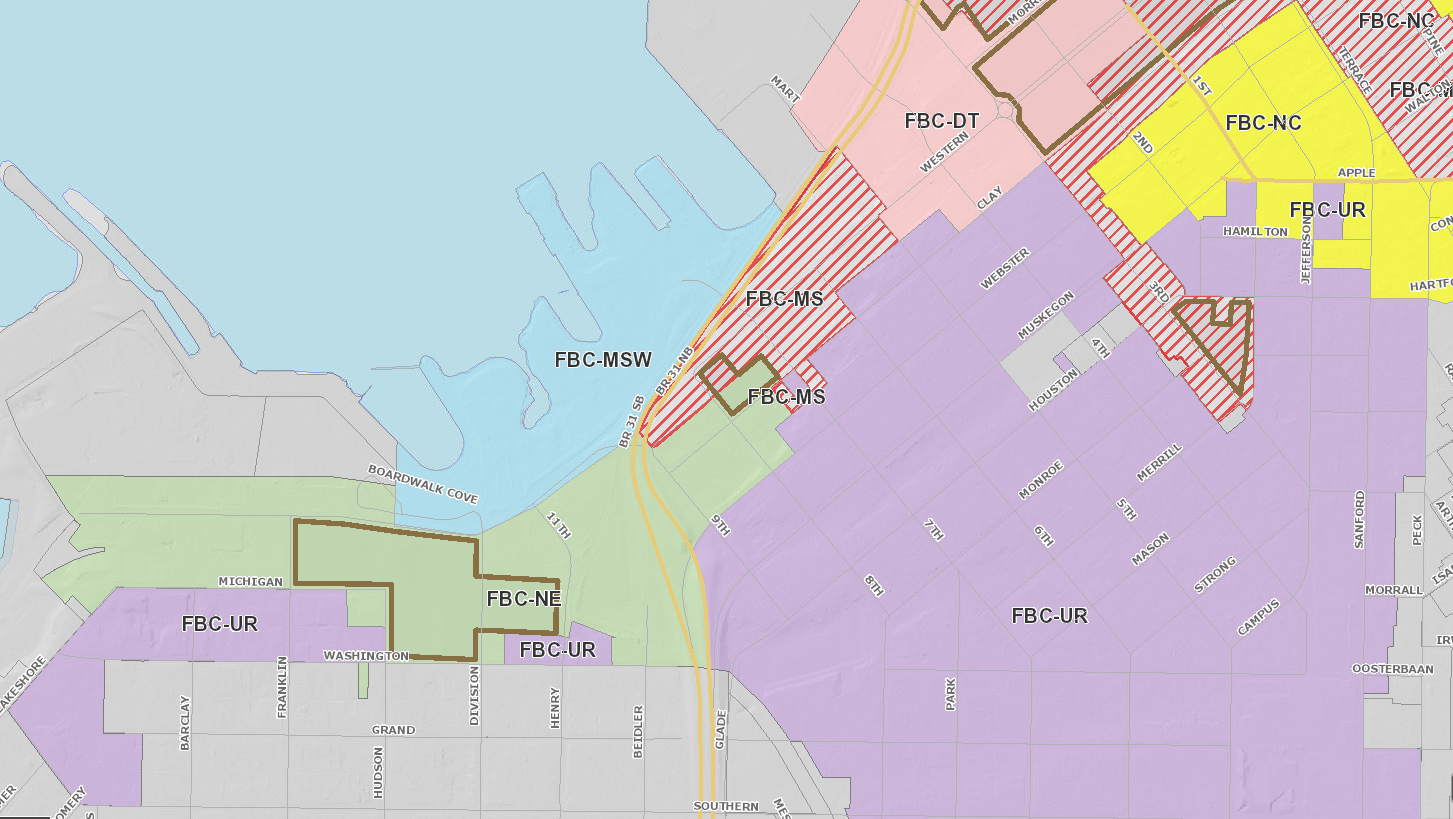
The weakest part of Muskegon’s Form Based Code is the Planned Unit Development, or PUD. This is a special provision that allows for a development to forgo rules imposed by the FBC. It’s purpose is to accommodate developments on sites with unusual topography or settings that make developing uniquely difficult. The danger is that in the process, large areas of the city are developed in a manner that is antithetical to the urban character of their original zoning. Harbor 31 is an example of this. Harbor 31 sits within effectively the entirety of the “Mainstreet Waterfront” area, which was intended to
“Provide a waterfront focal point that serves the city’s neighborhoods and the region by accommodating retail, service, and residential uses in a compact, walkable urban form.”
Instead, when it is built, it will effectively be designed similarly to a suburban condo complex. It does have guaranteed access to lakefront in two areas, but at the cost of the walkable public streetscape that this area could have been. Considering this development, future PUDs should be regarded with great skepticism.
In all, Muskegon’s Form Based Code is an asset to the city, and an aspect that sets us apart from many other cities in Michigan. It is a key part to making Muskegon a more walkable and interesting city to live in, and if the housing options it allows are actually built, it may lead to a more robust and affordable range of housing options in the future.
 The Muskegon Lumberman